

As a kid…
As a kid, I loved animals.
People? Meh.
Don’t get me wrong. I liked people just fine, but given the choice between watching a group of people going about their business and a magnificent lion stalking its prey, there wasn’t much of a contest. Being the boy that I was, I naturally gravitated toward the biggest, strongest, most magnificent meat-eaters.
Why? Because they were the coolest!
Very early in my childhood, I was particularly fond of lions. In fact, I had perfected my imitation of a male lion’s roar. And I’m not talking about just any lion. It had to be a proper male with a magnificent mane! I practiced so much that I occasionally drove my family crazy. The funny thing is that they would sometimes ask me to demonstrate my talents when we had visitors. Apparently, I was pretty good at it.
But my interest in animals went well beyond their ability to roar, hunt, or look intimidating. I wanted to know how they lived, how they moved, what they ate, and how they survived. How did they hunt? How did they reproduce and raise their young? And how on Earth could a caterpillar transform into something as different as a butterfly?
If an animal could breathe and move, I was interested. If a predator successfully caught its prey, I cheered. And if a baby animal grew into an adult that looked completely different, I wanted to understand how that was possible.
Books, magazines, television programs, documentaries. If they had something to do with animals or the natural world, I was there.
I didn’t know it then, but I was developing a lifelong fascination with biology.
The Pacific Ocean Was My Other Playground
I was born and raised in Lima, Peru, during the 1970s and 1980s.
For those unfamiliar with Lima, the Pacific Ocean is an important part of life there. Beaches, swimming, fishing, eating ceviche, and spending time along the coast were all familiar activities during my childhood. My family also belonged to a private club with large swimming pools, so I had plenty of opportunities to enjoy the water.
And I loved it.
Once I learned to swim, and particularly when I began exploring underwater with a diving mask, an entirely different world opened up to me. I could spend hours swimming, diving, and looking around beneath the surface.
But there was a problem.
I was a human being, a land-dwelling mammal. No matter how much I enjoyed being underwater, I couldn’t stay down very long, and I certainly couldn’t move through it with the ease of an animal that had evolved to live there. How could I become a better underwater explorer?
Naturally, my childhood mind went looking for a solution.
One day, while we were watching a documentary about marine life, my older brother pointed something out to me. Divers and underwater explorers, including people like Jacques Cousteau, seemed to move through the water in a particular way: their movements reminded us of dolphins.
That observation changed the way I approached swimming and diving! If I couldn’t become an aquatic animal, perhaps I could learn something by imitating one. So I began paying more attention to how marine mammals moved. Their streamlined bodies, the movements of their tails, and the apparent ease with which they traveled through the water fascinated me.
Of course, humans and dolphins have very different anatomies. A dolphin’s powerful tail flukes move up and down, while a human swimmer has to make do with two legs, arms, and a pair of lungs that demand regular trips to the surface. Still, observing their movements gave me ideas to experiment with in the water.
And among all those remarkable marine mammals, one became my absolute favorite.
Orcas: The Ultimate Marine Predators
Orcas, also known as killer whales, seemed to combine everything I loved about animals. They were big, powerful, intelligent, beautifully adapted to their environment, and formidable predators.
To me, they were simply magnificent.
One of the interesting things about orcas is that, despite being called killer whales, they are actually the largest members of the oceanic dolphin family. That’s right. The biggest dolphins in the world are orcas!
Their scientific name is Orcinus orca, and they belong to the family Delphinidae, alongside other oceanic dolphins.
According to NOAA Fisheries, orcas can be found in oceans around the world, and their populations display remarkable differences in diet, behavior, and hunting strategies. Some populations specialize in fish, while others hunt marine mammals. Their ability to coordinate their movements while hunting, often using techniques learned and passed down within their social groups, is particularly fascinating.
But my personal connection with cetaceans wasn’t limited to watching documentaries or reading books. I had the privilege of observing some of them in the wild.
Encounters Along the Peruvian Coast
During the 1980s, I practiced spearfishing along the Peruvian coast. Through that activity, I became friends with local fishermen, including people who worked as caretakers of fishing boats.
These weren’t necessarily fishermen who owned large vessels or operated the kind of recreational fishing boats people might picture in the United States. Some cared for other people’s boats and supplemented their income with occasional jobs or fishing from the rocky coastline, often using just a fishing line, without a reel or rod. Others owned small wooden rowboats, sometimes equipped with motors.
I had the opportunity to accompany some of these men to coastal areas and fishing grounds that were difficult for most people to access. One of the people I often went diving with was Willy, my spearfishing mentor. Like my family, he rented a house at the beach for the summer, and spearfishing was his hobby, too. He owned a wooden rowboat with a motor, which was looked after by a local fisherman who also became my friend. And this fisherman made me “earn” my place in the boat.
One encounter in particular has stayed with me all these years.
We were in a boat relatively close to a rocky shoreline when we saw a group of what appeared to be false killer whales feeding on fish. Now, I can’t claim to have positively identified the species. I was observing them from a boat, not conducting a scientific survey, but their appearance and behavior made me believe that’s what we were watching.
What fascinated me most was how they seemed to be working together. They were moving around the fish and thrashing their tails. I suspected they were attempting to stun their prey, although I couldn’t know that for certain from where I was watching.
It was an incredible sight!
Marine mammals hunting together, right there in front of us, with the rocky Peruvian coastline as a backdrop.
I was already familiar with the sophisticated hunting strategies some cetaceans use, including coordinating their movements to capture prey. I also knew that some species, like orcas, could use powerful tail movements to stun fish. Was that what I was witnessing right there off the Peruvian coast? I couldn’t say for certain, especially since I wasn’t completely sure which species we were watching. But seeing those animals apparently working together to catch their next meal was absolutely fascinating!
On other occasions, while traveling by boat to less accessible stretches of the Peruvian coast, we’d sometimes encounter dolphins and other small cetaceans swimming nearby, almost as if they were curious about us. Some of those places were difficult to reach by land, while others were accessible only by sea.
I never encountered an orca in the wild, but those experiences only strengthened my fascination with marine mammals.
There’s something special about observing an animal in its natural environment, following its own instincts and behavior, completely indifferent to whether you’re there to admire it.
Dinosaurs: The Animals I Could Never Meet
Of course, my love of powerful predators wasn’t limited to living animals.
Dinosaurs were another obsession.
And really, is anyone surprised? Imagine being a kid fascinated by lions, sharks, crocodiles, and other formidable predators, then discovering that creatures like Tyrannosaurus rex once walked the Earth. How could I possibly resist?
But dinosaurs presented a problem that was quite different from my fascination with marine mammals. I could visit the ocean and occasionally encounter dolphins. I could visit a zoo and observe a lion.
But I would never get to see a living Tyrannosaurus rex.
All I had were books, illustrations, magazines, documentaries, and movies. Occasionally, I would see photographs or footage of dinosaur skeletons displayed in museums in the United States or Europe, and I wanted desperately to see those skeletons for myself.
What fascinated me wasn’t just the size or appearance of these animals. It was the fact that we knew anything about them at all.
Think about it. The non-avian dinosaurs disappeared some 66 million years ago, long before humans ever walked the Earth. Yet scientists have managed to reconstruct their skeletons, investigate their diets, study their environments, and develop increasingly detailed explanations of how they moved and lived.
Of course, the fossil record is incomplete. We don’t know everything about extinct animals. Some aspects of their appearance and behavior may remain uncertain, and scientific interpretations change when new evidence becomes available.
But that’s precisely what makes paleontology so fascinating.
It’s an enormous scientific detective story, with pieces of evidence scattered across millions of years. And the detectives keep getting better at their jobs.
Finally, Face to Face with a T. rex
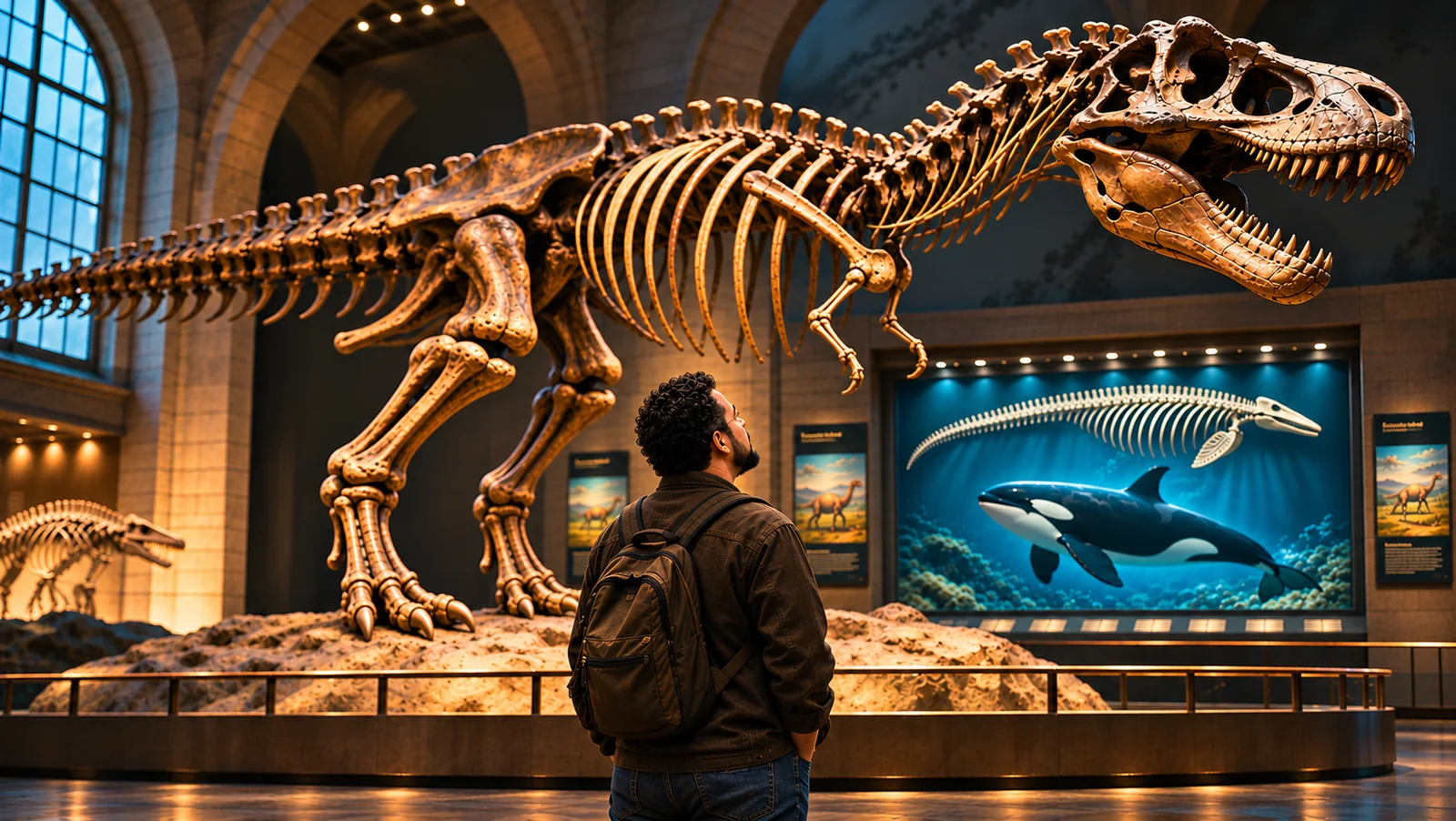
In late 1999, I visited New York City for the first time. My family and I were exploring the city with my older brother, who was living in New Jersey at the time. We had several places to visit, but there was one destination I wasn’t about to miss: the American Museum of Natural History.
I was twenty-eight years old by then, but when I entered that museum, I might as well have been a little kid again.
I was in heaven!
The exhibits, the history of life on Earth, the enormous blue whale suspended from the ceiling. Everywhere I looked, there was something I wanted to examine. What else was there to see? How much more could I learn? What amazing things did they have hidden away in collections that weren’t open to the public?
I normally try to maintain a fairly relaxed demeanor, but that day I wasn’t particularly interested in playing it cool. I could have gone back every day for a year and probably still wouldn’t have had enough.
And then, finally, the dinosaurs.
Seeing those skeletons in person was something no book or photograph could properly prepare me for. For the first time, I could truly appreciate their scale. Some were enormous. Others were surprisingly small. But every one of them represented an animal that had once been alive, moving through an environment that no longer existed.
I enjoyed every last one of them, but I had come to see the star of the show: Tyrannosaurus rex.
Come on. Isn’t that the dream of just about every dinosaur-obsessed kid?
And the first thing I noticed was something that demonstrated exactly why I find science so exciting.
Its posture had changed.
When the American Museum of Natural History first mounted its Tyrannosaurus rex skeleton in 1915, the dinosaur was displayed in a mostly upright posture. Its body was raised, and its tail extended downward toward the ground.
For generations, that image influenced how people imagined T. rex and many other large, two-legged dinosaurs. But scientific understanding continued to evolve.
By the early 1990s, the museum had reconstructed the skeleton in a more horizontal, forward-leaning posture. The head was lowered, the tail was lifted off the ground and extended backward, and the enormous body was balanced over the hips. It was still the magnificent predator I had admired since childhood, but scientists had changed how they understood its anatomy and movement.
That was the animal I saw in 1999… And I loved that!
To me, the revised skeleton wasn’t evidence that scientists had failed. It was evidence that science was working. New discoveries, improved methods, and fresh examinations of existing evidence had produced a better explanation.
Of course, our understanding of dinosaurs has continued to change since then. Feathers, coloration, growth, behavior, relationships between species, and even the way we classify certain animals have all been subjects of ongoing research. But those are stories for another article.
And as much as I love dinosaurs, paleontology has given me another reason to be fascinated with whales. After all, these magnificent marine mammals didn’t always look anything like the animals we know today. Their ancestors once walked on land, and over millions of years, their descendants evolved into some of the most extraordinary creatures inhabiting our oceans.
Now, how could I not find that fascinating?
When Marine Biology Meets Paleontology
Here’s something I find absolutely fascinating: the ancestors of all terrestrial vertebrates ultimately trace back to aquatic organisms. Over hundreds of millions of years, some vertebrate lineages became adapted to life on land. Much later, one lineage of land mammals began adapting to life in the water again, eventually giving rise to whales and dolphins. And thanks to fossils, comparative anatomy, genetics, and other scientific disciplines, we can reconstruct much of that remarkable evolutionary journey!
The Smithsonian has an excellent illustration of this process called Whales Returned to the Sea. Its broader overview of whales and dolphins also provides fascinating information about these animals and their evolutionary history.
This return to the ocean by land animals wasn’t unique to cetaceans. During the age of dinosaurs, several unrelated groups of reptiles also returned to the water. Some eventually became formidable marine predators, including ichthyosaurs, plesiosaurs, and mosasaurs. They weren’t dinosaurs themselves, but they were every bit as fascinating.
But I digress.
Early cetaceans such as Pakicetus retained many adaptations associated with life on land. Later forms, including Ambulocetus, show combinations of terrestrial and aquatic characteristics. Eventually, ancient whales such as Basilosaurus became fully aquatic, although they still possessed small hind limbs.
These animals weren’t necessarily successive ancestors in a neat, straight line. Evolution is a branching process, and the fossils represent different parts of a much larger family history. Collectively, though, they document one of the most remarkable evolutionary transitions known to science.
And here’s where the story becomes particularly interesting to me.
In 2019, researchers described fossils of an ancient whale discovered in Peru. They named it Peregocetus pacificus. This animal lived approximately 42.6 million years ago and possessed four limbs capable of supporting it on land, along with anatomical adaptations for swimming.
Imagine that!
An ancient whale that could move through the water and still walk on land, discovered in the same country where I grew up swimming, diving, and dreaming about marine animals. The discovery also provided important evidence about how early whales dispersed from their ancestral regions into other parts of the world.
But Peru had another remarkable cetacean fossil discovery to offer, and this one would have driven my younger, predator-obsessed self absolutely crazy!
Meet Livyatan melvillei.
Described in 2010 from fossils discovered in southern Peru, Livyatan was an enormous predatory sperm whale that lived approximately 12 to 13 million years ago. Unlike today’s sperm whales, which primarily hunt squid and other deep-sea prey, Livyatan had enormous, functional teeth in both its upper and lower jaws. Some of those teeth were more than 36 centimeters (14 inches) long!
Its skull alone measured approximately three meters (almost ten feet). Based on its anatomy, researchers proposed that this formidable predator may have hunted other whales.
And, to make things even more interesting, it shared the oceans of its time with another giant predator: megalodon, the enormous extinct shark.
Now, that’s an ocean I would have loved to explore! Very carefully, though…
Think about it. On one hand, we have Peregocetus, an early whale that lived about 42.6 million years ago and was still capable of moving on land. On the other, we have Livyatan, an enormous, fully aquatic whale that was among the most formidable marine predators of its time, some 12 to 13 million years ago. They belonged to different branches of the cetacean family tree, separated by roughly 30 million years of evolutionary history, and fossils of both were discovered in Peru! One helps us understand how whales adapted to life in the water, while the other shows just how powerful and specialized some later whales became.
This is the kind of science that keeps me fascinated. We aren’t simply discovering unusual animals. We’re gradually reconstructing the enormous evolutionary history that connects the living world around us with creatures that disappeared millions of years ago.
The More We Discover, the More Questions We Can Ask
One of the things I admire most about science is its ability to correct itself. Scientists develop explanations based on the best evidence available, test them, challenge them, and revise them when new discoveries reveal something unexpected. To me, that isn’t a weakness. Quite the opposite! It’s one of the reasons I find science so fascinating.
Think about the dinosaurs I admired as a child. The illustrations in my books reflected what scientists understood at the time. By the time I stood in front of that magnificent T. rex skeleton in New York, some of those ideas had already changed dramatically. And today? Well, scientists are still discovering things about these animals that would have been difficult to imagine when I was a kid.
The same goes for cetaceans. The more we learn about their anatomy, behavior, intelligence, and evolutionary history, the more questions seem to emerge. And that, to me, is half the fun!
I never became the scientist I imagined I might be as a child. Life took me in other directions, and I eventually built a career around computers, technology, design, and education. But my fascination with the natural world never went away. I still get excited when I learn about an unusual animal behavior, a remarkable fossil discovery, or some new piece of evidence that changes what we thought we knew.
I suppose that little boy who drove his family crazy roaring like a lion never really grew up. He’s still there, fascinated by the same animals, still wanting to understand how they lived, and still getting excited whenever there’s something new to discover.
The difference is that, after all these years, I have a much better understanding of just how much I don’t know.
And I love that!
Scientific References and Further Reading
The following resources provide additional scientific background on the animals, discoveries, and evolutionary history discussed in this article.
- NOAA Fisheries. Killer Whale (Orcinus orca). Biology, ecology, distribution, social behavior, and hunting strategies.
- NOAA Fisheries. False Killer Whale (Pseudorca crassidens). Identification, feeding ecology, and social behavior.
- American Museum of Natural History. A Century of T. rex at the Museum. The museum’s historic Tyrannosaurus rex mount and its reconstruction.
- Smithsonian Ocean. Whales and Dolphins. Cetacean anatomy, diversity, behavior, and evolutionary history.
- Smithsonian Ocean. Whales Returned to the Sea. Illustrated overview of the evolutionary return of whale ancestors to aquatic life.
- Lambert and colleagues (2019). An Amphibious Whale from the Middle Eocene of Peru Reveals Early South Pacific Dispersal of Quadrupedal Cetaceans. Current Biology. Original research describing Peregocetus pacificus.
- Lambert and colleagues (2010). The Giant Bite of a New Raptorial Sperm Whale from the Miocene Epoch of Peru. Nature. Original research describing the predatory sperm whale subsequently named Livyatan melvillei.