
I’ve been fascinated by science for as long as I can remember. Growing up in Lima, I was always curious about how the world worked and eager to discover the explanations behind things I didn’t understand. Science seemed like an endless source of fascinating questions and even more fascinating answers.
That changed in an unexpected way when I discovered Carl Sagan’s Cosmos: A Personal Voyage during my Middle School years. Until then, I’d been fascinated by what science had discovered. Sagan introduced me to something even more remarkable: how those discoveries were made, the people and history behind them, and how centuries of scientific progress had helped humanity understand the universe and our place in it.
My First Voyage Through the Cosmos
I still remember that Saturday afternoon at my grandmother’s house in Lima, just before lunch.
I’d been watching cartoons, followed by a marine documentary about cuttlefish. It was the sort of afternoon when I’d happily watch anything that had something interesting. Then, seemingly out of nowhere, something different began.
First came the music by Vangelis. Then the dark background, the stars and galaxies appearing to float toward me, and finally the word Cosmos filling the center of the screen.
I figured it was going to be another one of the many science documentaries I’d already watched. Probably much of the same information, perhaps with a few new discoveries or interesting details thrown in. I certainly wasn’t expecting anything that would fundamentally change my understanding of science.
Little did I know what I was about to discover. As it turned out, I hadn’t even started with the first episode.
Back then, television stations in Peru didn’t always broadcast imported programs in their entirety, much less in the correct order. The first episode of Cosmos I happened to watch was actually the second one, One Voice in the Cosmic Fugue.
And one of its stories immediately caught my attention.
Carl Sagan told the story of the Heike crabs of Japan, whose shells have markings that resemble the faces of samurai warriors. He connected an old Japanese legend with questions about evolution and the ways human activity can influence living things.
I was hooked! Here was a science documentary that began telling me about Japanese history, folklore, and samurai, then somehow turned it into a discussion about biology and evolution.
That wasn’t quite what I’d expected.
Sagan’s particular explanation for the crabs’ markings has since been challenged, but what made the story memorable to me was the way he connected subjects I had previously thought of as unrelated.
Then came another revelation: the Cosmic Calendar, sometimes called the Cosmic Year.
Sagan compressed the entire history of the universe into a single year, making billions of years suddenly easier to comprehend. The appearance of life on Earth, the evolution of different species, and our own remarkably recent arrival became part of a timeline I could actually begin to understand.
And the computer animation showing the evolution of life on Earth absolutely blew me away. Watching organisms change and develop across enormous stretches of time brought something I’d previously encountered mostly through books and illustrations to life on the television screen. It was an extraordinary experience, especially for a kid who was already fascinated by biology and the natural world.
At the time, that computer animation was groundbreaking, and the music accompanying it made the experience even more wonderful and inspiring.
Between the Heike crabs, the Cosmic Calendar, and that remarkable animation, I was beginning to realize that Cosmos was something quite different from the documentaries I’d grown accustomed to watching.
And it was only the beginning.
More Than Science, More Than a Documentary
What made Cosmos different wasn’t simply the information it presented. Carl Sagan connected science with history, philosophy, mathematics, and human civilization, showing not just what we knew, but how we’d come to know it. Scientists were no longer names attached to discoveries. They became people whose curiosity, persistence, mistakes, and sometimes considerable personal sacrifices had helped expand our understanding of the world.
Sagan made science feel like a continuing human adventure rather than a finished collection of facts in a textbook. I was beginning to realize that the history of science was inseparable from the history of humanity.
And then there was the music.
I’ve always loved both classical and modern music, so the soundtrack was another aspect of Cosmos that immediately appealed to me. Vangelis’s opening theme was unforgettable, but it was the variety of music throughout the series that made the experience even more special. Classical compositions mixed with contemporary electronic music and music from other traditions, sometimes creating a sense of wonder and excitement, other times adding mystery or emotion to the stories Sagan was telling.
The music wasn’t simply something playing in the background. It was part of the storytelling, working alongside the images and narration to make the experience even more memorable.
Looking back, I think that’s another reason the series had such an impact on me. It appealed to several of my interests simultaneously. Science, history, music, technology, and the sheer enjoyment of a well-told story were all there.
I’d never experienced anything quite like it.
Discovering How We Discovered
One of the most fascinating things about Cosmos was its treatment of the history of science.
Take the ancient Greek scholar Eratosthenes, for example. More than two thousand years ago, he used observations of shadows in different locations and some remarkably clever geometry to estimate the circumference of Earth.
Think about that for a moment.
No satellites. No modern measuring instruments. No computers. Just careful observation, mathematics, and the ability to recognize what the evidence was telling him. The story wasn’t merely about someone figuring out the size of our planet. It was about realizing that an enormous question could be answered by observing something as ordinary as a shadow.
Sagan also introduced me to early Greek thinkers who attempted to explain the natural world through observation and reasoning rather than simply accepting traditional explanations. The ancient Ionians were particularly interesting because they represented an important stage in the development of natural explanations for phenomena that earlier generations had often attributed to supernatural forces.
The fascinating part wasn’t that they had all the answers. They certainly didn’t. It was that they were beginning to ask questions in ways that could eventually lead to better ones.
Then there was Johannes Kepler.
Sagan’s account of Kepler and the observations of Tycho Brahe offered another extraordinary lesson about how science works. Kepler was searching for an elegant mathematical explanation of planetary motion, and he had strong ideas about the harmony and order of the universe.
But the observations didn’t always cooperate.
Kepler had to confront the uncomfortable reality that planetary motion didn’t fit some of his most deeply held assumptions. He believed that God’s creation followed an elegant mathematical order, and for years he searched for the perfect geometric relationships that would explain the movements of the planets. Ultimately, he abandoned the idea that planets must travel in perfect circles and discovered that their orbits were elliptical, challenging the long-held belief that heavenly bodies had to move in perfect circles.
What impressed me about that story was the persistence involved, but also the willingness to follow the evidence even when it contradicted a beautiful idea he had invested so much into.
Scientific progress wasn’t simply a matter of clever people coming up with brilliant explanations. It involved difficult work, mistaken assumptions, repeated calculations, and the willingness to recognize when something didn’t fit. Sometimes being wrong was an essential part of discovering what was right. I began to understand that science wasn’t a finished collection of answers, but a method for finding better ones.
That distinction has stayed with me ever since.
The Great Library of Alexandria
Another discovery I owe to Carl Sagan was the Great Library of Alexandria, which became one of my favorite subjects in history.
The very idea fascinated me: people in the ancient world attempting to gather, organize, preserve, and study the accumulated knowledge of different civilizations. Imagine the ambition behind such an undertaking, particularly in an era when books had to be copied by hand and knowledge traveled across enormous distances through trade, exploration, and human contact.
Carl Sagan connected science with history, philosophy, mathematics, and human civilization, showing not just what we knew, but how we’d come to know it.
The Library of Alexandria represented something I hadn’t fully appreciated before. Human progress wasn’t simply the result of isolated individuals making brilliant discoveries. It also depended on preserving what others had learned and making that knowledge available to future generations.
Sagan’s discussion of Alexandria helped me see how closely science and history were connected. Knowledge could accumulate and spread, but it could also be neglected, suppressed, or lost. The decline of the Great Library of Alexandria made me wonder how much knowledge might have disappeared forever, and what discoveries might have been possible had that knowledge survived.
And progress wasn’t guaranteed.
The history of science isn’t a straight line from ignorance to enlightenment. People have spent thousands of years trying to explain the natural world, often relying on the knowledge, traditions, and beliefs available to them. Some explanations survived for centuries. Others eventually gave way when new observations and better evidence became available.
Political and religious authorities sometimes resisted discoveries that challenged accepted ideas. Scientists themselves weren’t immune to the prejudices and limitations of their times, either. Understanding that history made scientific achievements even more impressive to me. It also helped me appreciate why questioning, testing, preserving knowledge, and openly examining ideas matter so much.
The history of science isn’t simply a record of brilliant discoveries. It’s also a record of human curiosity, persistence, mistakes, disagreements, and occasional stubbornness.
In other words, a very human story.
From Huygens to Voyager, and a Pale Blue Dot
Another connection that fascinated me was how Sagan brought together discoveries and achievements separated by centuries.
In Cosmos, he explored the work of Christiaan Huygens, the seventeenth-century Dutch scientist whose contributions to astronomy helped expand humanity’s understanding of the solar system. Huygens studied Saturn and its rings, discovered its moon Titan, and developed ideas about the nature of other worlds using the observations and scientific instruments available to him.
Centuries later, spacecraft such as NASA’s Voyager missions were traveling through the outer solar system, sending back information and images of places that earlier astronomers could only study from a distance.
I found that connection extraordinary.
Here were human beings separated by hundreds of years, working with vastly different technologies, yet contributing to the same continuing effort to understand the universe. Huygens couldn’t have imagined the instruments that would eventually allow us to examine other worlds so closely. And the scientists and engineers who developed those spacecraft depended on generations of discoveries that came before them.
One discovery made another possible, which led to another, and eventually humanity was sending machines to explore other worlds. That idea fascinated me as much as the spacecraft themselves.
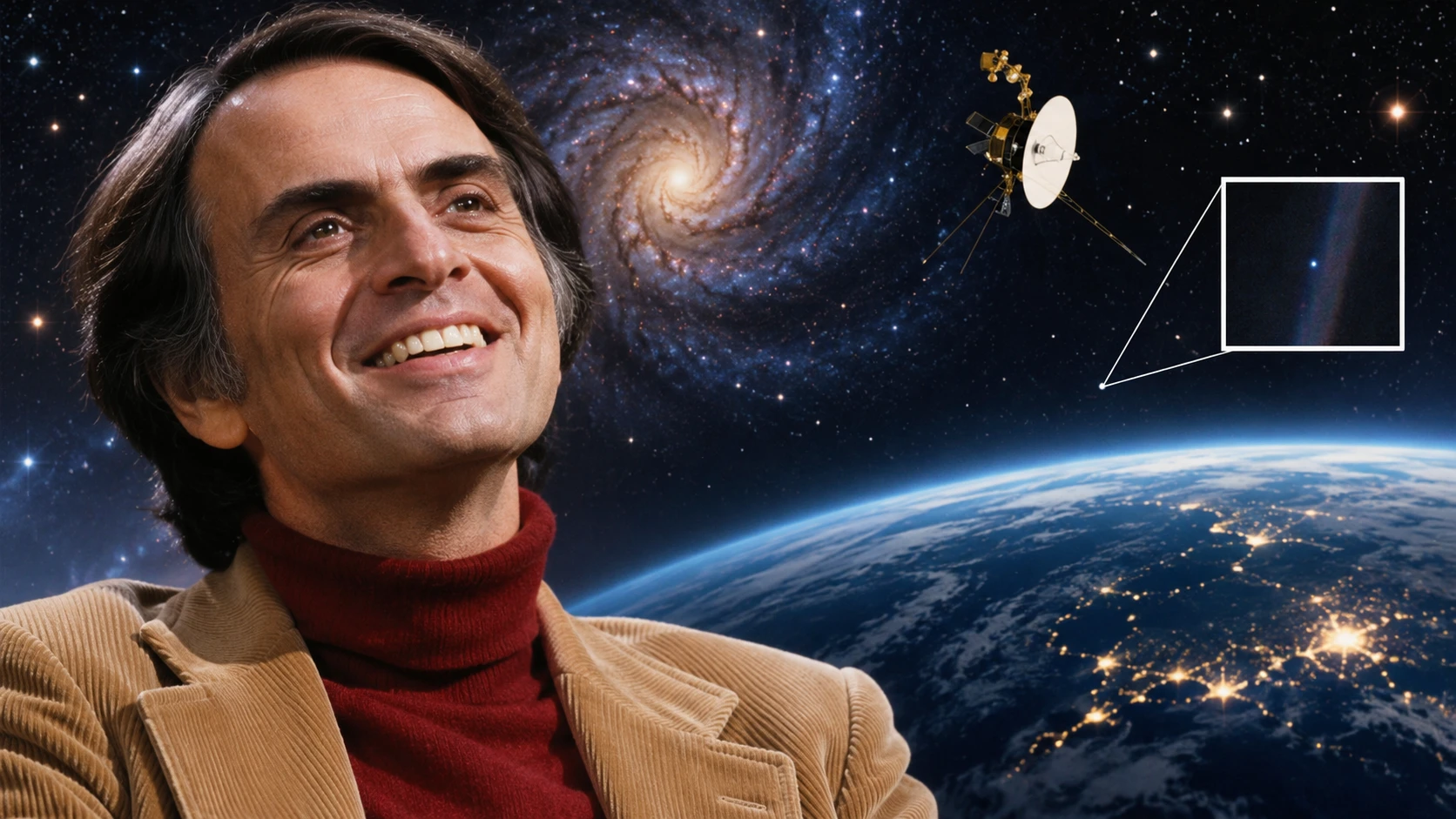
Years later, Carl Sagan would inspire me again with something that wasn’t part of Cosmos: Pale Blue Dot.
In 1990, at Sagan’s suggestion, Voyager 1 turned its camera back toward Earth from roughly six billion kilometers (almost four billion miles) away. The resulting photograph showed our entire world as a tiny speck of light, almost lost in the vastness of space.
Sagan’s reflections on that image, which I later encountered in a video featuring his narration, affected me tremendously. It was everything about his message: how insignificant our conflicts and divisions seem when viewed against the enormous scale of the universe, how fragile our planet really is, and how every human being who has ever lived has shared that same tiny world.
What struck me most was the way Sagan brought those ideas together, reminding us that, despite all our differences, Earth is the only home we’ve ever known.
Cosmos had helped me understand how humanity came to know so much about the universe. Pale Blue Dot made me think more deeply about what that knowledge should teach us about ourselves.
The Curiosity Never Went Away
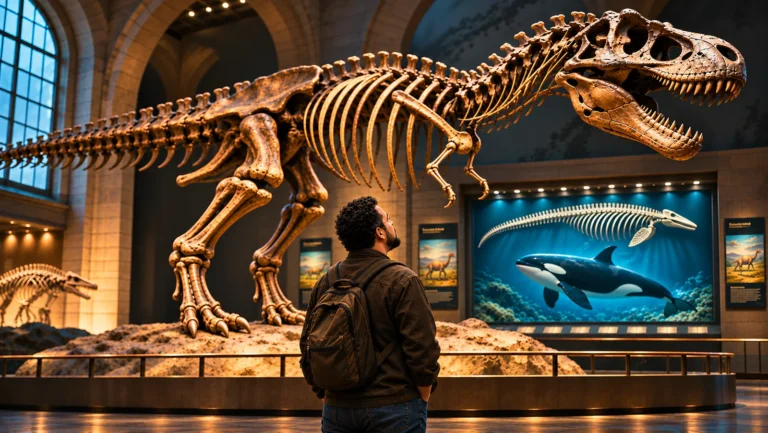
My fascination with science has only grown since those Middle School years. I still enjoy learning about new discoveries, but I’m just as interested in the history and people behind them. And my fascination with the natural world hasn’t diminished either, something I’ve written about in From Dinosaurs to Orcas: My Lifelong Fascination with the Natural World.
Over the years, I’ve continued watching science documentaries, including History Channel’s The Universe and Science Channel’s The Planets and Beyond. I’ve also become a fan of physicist Brian Cox and his programs, including Wonders of the Solar System, Wonders of the Universe, Wonders of Life, Human Universe, The Planets, and Universe. And, of course, I was delighted when Cosmos returned with Neil deGrasse Tyson in A Spacetime Odyssey and Possible Worlds.
I never became a professional scientist, but I’ve never stopped being curious. I still enjoy that moment when a scientific explanation suddenly makes something click, and I suppose that’s one reason I’ve always enjoyed explaining things to other people, too.
Carl Sagan didn’t create my love of science. That was already there. What he did was give that curiosity a new perspective.
I was already fascinated by what we had discovered. Carl Sagan helped me appreciate how we discovered it.
And that made all the difference.
Scientific References and Further Reading
The following resources provide historical and scientific background for some of the people, discoveries, and ideas discussed in this article.
Carl Sagan and Cosmos
- Cosmos: A Personal Voyage – Smithsonian Institution. An archival record of the original 1980 television series.
- One Voice in the Cosmic Fugue – Australian Centre for the Moving Image. Information about the second episode, including its evolutionary animation and the Heike crabs.
- Cosmos: An Appreciation – Library of Congress. Carl Sagan discusses the ideas and reasoning behind creating the original television series.
Scientific Discoveries and History
- The Cosmic Calendar – International Space & Science Coalition. An interactive version of Sagan’s idea of compressing the universe’s history into a single year, using updated cosmological estimates.
- The History of Geodesy – National Oceanic and Atmospheric Administration (NOAA). Explains how Eratosthenes estimated Earth’s circumference using shadows and geometry.
- Orbits and Kepler’s Laws – NASA. An introduction to planetary motion and Kepler’s contributions to astronomy.
- Library of Alexandria: Assessing the Evidence – The Open University. A historical examination of the library and the evidence surrounding it.
- Voyager Mission – NASA. Information about the spacecraft that transformed humanity’s exploration of the outer solar system.
- Voyager 1’s Pale Blue Dot – NASA. The photograph of Earth taken by Voyager 1 in 1990, its historical background, and its connection to Carl Sagan.
Music and Visual Storytelling
- The Music of Cosmos – MusicBrainz. Recording information for selections from the original television series’ soundtrack.
- Animating the Evolutionary Process in Carl Sagan’s Cosmos – Animation Studies. An academic examination of the evolutionary animation featured in the original series.